Contribute
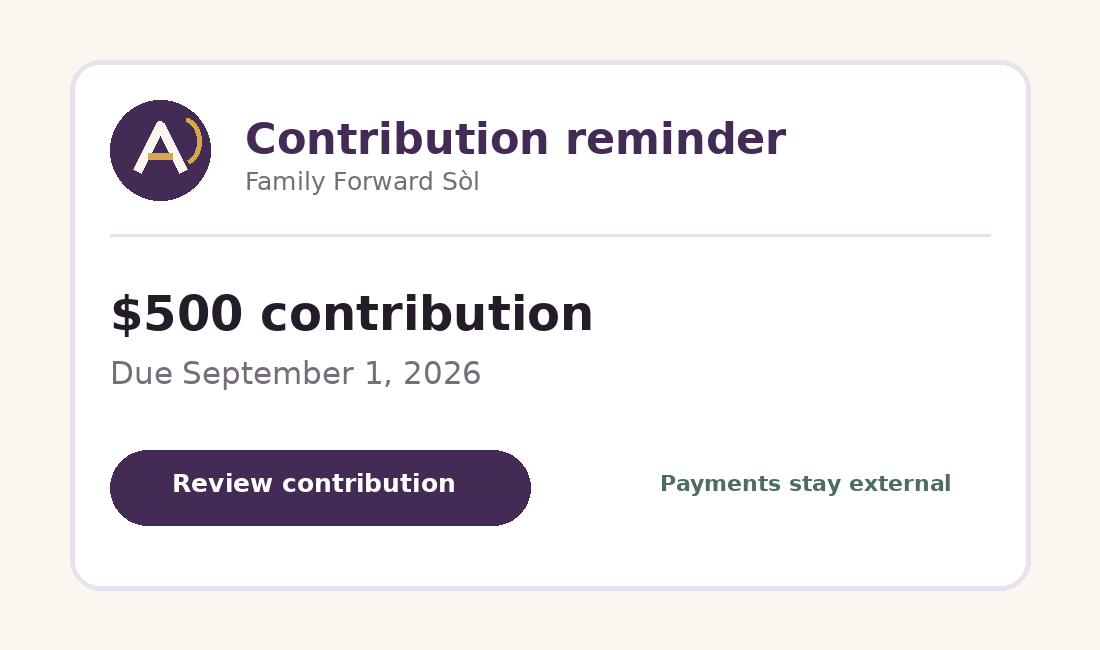
Members add the agreed amount on schedule.

Ansava currently uses sample data only. The features, identity verification, agreements, protections, enrollment, and pricing described below are planned and inactive pending legal and provider approval. Do not use Ansava for real contributions or payouts.
Community knowledge
Explore how communities around the world describe and practice rotating savings circles.
Published by Ansava · Last reviewed August 30, 2026
ROSCA
ROSCA / savings circle is a local name or description for a rotating savings and credit association, or ROSCA. A group agrees on a contribution and schedule. At each turn, everyone contributes and one participant receives the pooled amount. The cycle continues until every participant has received a turn.
Members add the agreed amount on schedule.
One participant receives that round’s pooled sum.
The recipient changes until everyone has had a turn.
ANSAVA
Keep the contribution, schedule, receiving order, and expectations in one place.
Help members see what is due, when it is due, and whose turn comes next.
Give the group a consistent view of completed and upcoming rounds.
Keep notices, confirmations, and participation history easier to review.
ANSAVA
Ansava helps people organize and understand savings circles while keeping the trust, relationships, and participant-to-participant payments at the center.
Community knowledge
Rotating savings circles were not invented by Ansava, a bank, or a single country. Researchers have documented related community practices across the world for generations.
Communities use familiar names such as ROSCA, sòl, tanda, tontine, susu, partner, and box hand. These practices are rooted in trust, mutual aid, and community relationships.
ROSCA
These are representative names reported in academic and development literature. Spelling, pronunciation, and practice can vary—even within the same country.
A shared name does not guarantee the same rules. Some terms also cover related models, including accumulating groups, auction circles, commercial consórcios, or regulated chit funds. People should understand the specific rules and local law before participating.
ANSAVA GUIDES
This public guide is educational, not legal or financial advice.
← Back to Ansava